Most people know the bridge on the River Kwai from the 1957 film. The real story is harder. In 1942 and 1943, the Japanese army forced Allied prisoners of war and Asian labourers to build a railway from Thailand to Burma, 415 kilometres through jungle and mountains, in about a year and a half. It became known as the Death Railway.
The town of Kanchanaburi, about 130 kilometres west of Bangkok, is where you can still see that history: the cemetery, the museum, the bridge and the railway line itself, which trains still run on today. It is one of the most moving days you can spend in Thailand.
Getting there
| Option | Time each way | Cost | Good for |
|---|---|---|---|
| Car or taxi | About 2 hours on the new motorway | Price of a private car | Fitting everything into one day |
| Train from Thon Buri | About 3 hours to Kanchanaburi | ฿100 flat fare for foreigners | Two-day trips, train lovers |
| Weekend excursion train | Leaves Hua Lamphong early on weekends | From about ฿120 | A day out at Thai pace |
| Private tour | Door to door, about 9 hours in total | From about $112 per person | One day, no logistics, a guide |
By car it is about two hours on the M81 motorway, depending on traffic getting out of Bangkok.
By train it is slower but part of the experience. Regular trains to Kanchanaburi leave from Thon Buri station (also called Bangkok Noi) on the west bank of the river, not from the main stations. There are only two a day, early morning and early afternoon, with third-class wooden or padded seats, fans and open windows. Foreigners pay a flat ฿100 to any station on the line, including the bridge and the end of the line at Nam Tok. You buy the ticket on the day. On weekends there is also an excursion train from Hua Lamphong, popular with Thai day-trippers.
The catch with the train: the morning train reaches Kanchanaburi around mid-morning, and the last train back leaves in the early afternoon. That is enough for the town, but not for the scenic stretch of the railway further up the line. If you want both by public transport, stay a night.
What to see, in the right order
Kanchanaburi War Cemetery. Start here, in the middle of town. Almost 7,000 prisoners of war are buried in neat rows, most of them British, Australian and Dutch, many in their early twenties. The cemetery is free and beautifully kept by the Commonwealth War Graves Commission. Walk along a row and read the ages and the short lines the families chose. It is quiet, and it stays with you.
Thailand-Burma Railway Centre. Right next to the cemetery, and the best museum on the subject. It explains how the railway was built, how the camps worked and what the prisoners lived on, with maps, objects and personal stories. Allow an hour or more. It is open daily from 9 am, and the ticket is around ฿140 to ฿160. If you only visit one museum, make it this one, and visit it before the bridge: everything afterwards makes more sense.
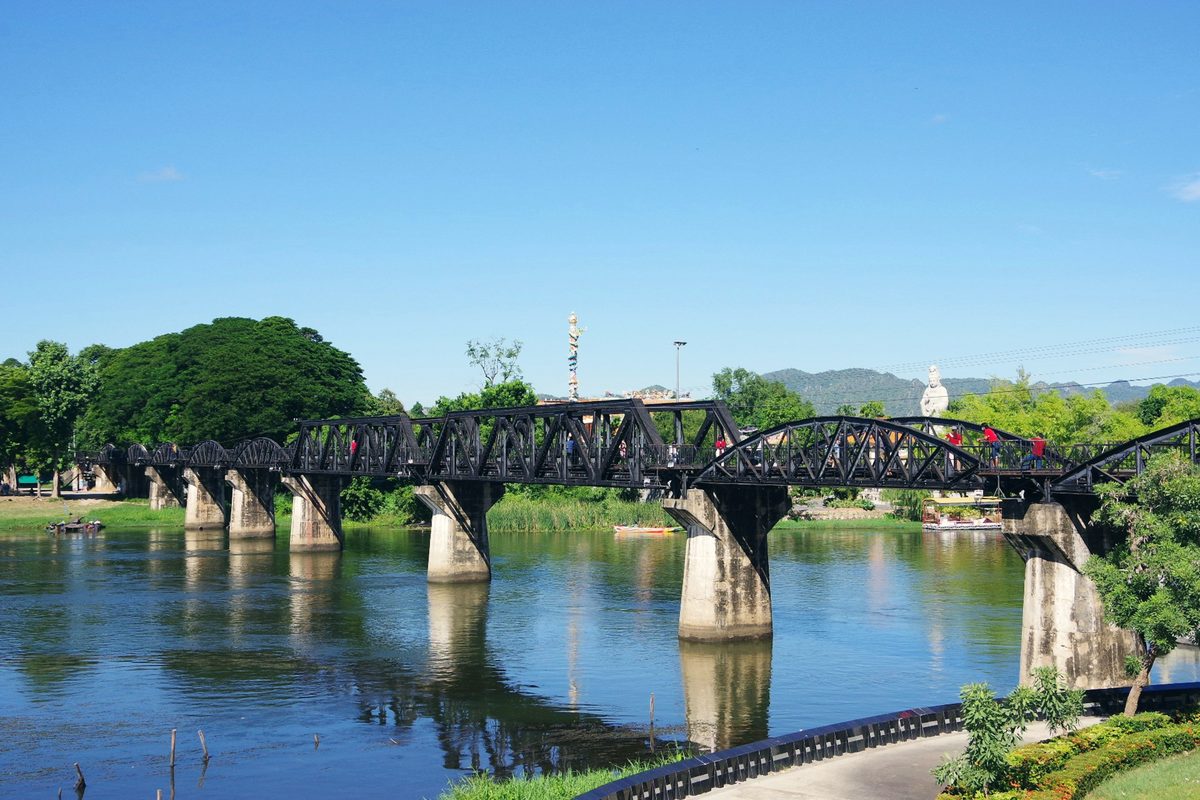
The bridge. A few kilometres north of the centre. You can walk across it, and trains still cross a few times a day, slowly, with small platforms along the side to step onto. The curved spans are the original ones; the two straight sections in the middle were rebuilt after Allied bombing in 1945. Around the bridge it is busy with stalls and tour groups. Go early or late if you can.
The Death Railway ride. The part people remember most is further up the line, where the track runs along a cliff above the river on a wooden viaduct near Tham Krasae. Many tours put you on the train for this stretch. Sit on the river side, which is the left-hand side going towards Nam Tok.
If you stay longer. About 80 kilometres further north is Hellfire Pass, a cutting the prisoners dug through solid rock by hand, with an Australian-run memorial and a walking trail. And Kanchanaburi is also the base for Erawan National Park and its waterfalls. Doing the history and Erawan in one day is possible on a tour, but it is a very long day. Kanchanaburi is also where you will find the elephant sanctuaries closest to Bangkok.
A simple plan
With a car or a tour (one day):
- Leave Bangkok early.
- War cemetery and Railway Centre.
- The bridge.
- Lunch by the river.
- A ride on the Death Railway over the viaduct.
- Back in Bangkok in the evening.
By train (better as two days):
- Morning train from Thon Buri to Kanchanaburi.
- Cemetery, Railway Centre and the bridge in the afternoon. Sleep in town.
- Next morning, the train up the line over the viaduct, then back to Bangkok by train or minivan.
Comparing your options? Our day trips from Bangkok guide puts them side by side.
Good to know
- Dress respectfully at the cemetery: no beachwear, and keep your voice down.
- It is hot. Bring water, a hat and sunscreen. There is little shade at the bridge and the station.
- Bring cash for the train, the museum and lunch.
- Kanchanaburi is not only sad. The town is relaxed, there are floating restaurants and guesthouses on the river, and an evening there is a nice change from Bangkok.
Tour or on your own?
If you have two days, doing it yourself by train is cheap and rewarding. In one day, it is hard: two trains a day, sites spread across town and the best part of the railway too far up the line to reach and get back in time.
That is where a private day trip makes sense. A driver picks you up at your hotel, a guide takes you through the cemetery, the museum and the bridge, the train ride and lunch are included, and the guide ties it all together into one story. You are back in Bangkok in the evening.
If you go on your own, read a little about the railway before you go, or buy one of the survivors’ memoirs. Standing on that bridge feels very different when you know a few of the names.
Sources: Commonwealth War Graves Commission, State Railway of Thailand timetables and fares, Thailand-Burma Railway Centre. Prices checked November 2026.